


September 2026 Honey Harvest

There are few things more rewarding in beekeeping than opening a hive and realizing your bees have been very busy. A week before our latest honey harvest, I attempted to inspect our hives by myself. I quickly discovered I wasn’t going to get very far. The boxes were so incredibly heavy with honey that I physically couldn’t lift them on my own to complete the inspection. While an abundance of honey is certainly a good problem to have, it can become a problem nonetheless.
When a Hive Starts Running Out of Room
A thriving colony needs space for two very important things: brood and food.
The queen spends much of her day laying eggs to maintain the colony’s population, while thousands of worker bees are simultaneously leaving the hive to collect nectar and pollen. As those resources come back into the hive, the workers begin filling available cells with food.
If too much of the available comb becomes occupied by honey and pollen, the queen can eventually lose the open cells she needs for laying brood. Beekeepers commonly refer to this situation as becoming "honey-bound".
Severe crowding can also contribute to a colony’s tendency to swarm, which is why providing adequate space and regularly inspecting a rapidly growing hive is so important. A strong colony needs room not only to store its food, but also to continue raising the next generation of worker bees.
And our bees had certainly been storing food.
Nearly 70% Honey and Pollen
Once Kyle and I were able to inspect the hive together, we found that nearly 50-60% of the available space was occupied by honey and pollen.
We also found newly laid eggs, which was exactly what we wanted to see. Our queen was there and actively laying. But looking at how quickly the remaining space was disappearing, we knew she was going to need more room soon.
So, we decided it was time to harvest.
We removed three beautiful frames that were completely capped with honey on both sides.
One of the most fascinating things about honeybees is how precisely they manage their food stores. Bees reduce the moisture content of nectar as it becomes honey, and once it is sufficiently ripened, they seal the cell beneath a thin layer of beeswax.
For us as beekeepers, those wax cappings are one of the best indicators that the honey is ready to harvest. We prefer harvesting frames that are approximately 90–100% capped so we know the honey has been properly ripened before extraction.

A Little Unexpected Comb
We also ended up harvesting an additional section of honeycomb that we hadn’t originally planned on taking.
The bees had built comb along the inside wall of the hive rather than keeping everything neatly contained within the frame. When we attempted to remove the frame, the comb remained attached to the hive wall.
Sometimes the bees simply don’t follow our plans.
We carefully scraped the comb from the side of the hive, strained the honey, and saved the beeswax to render down. That wax will eventually be given another life in some of our handcrafted bath and body products here on the farm.
Nothing goes to waste.
From Hive to Honey Jar
Then came the really fun part.
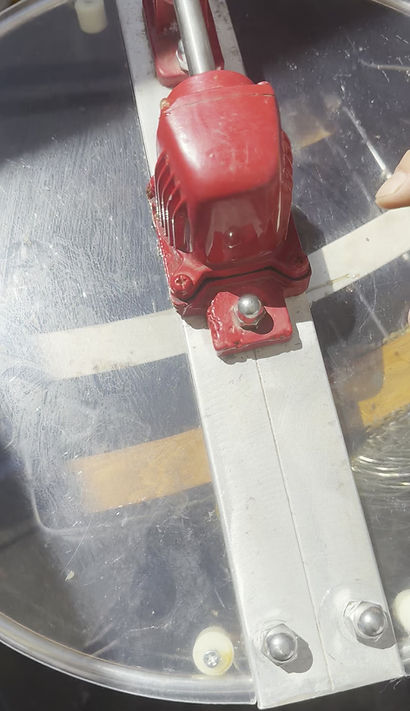
We scraped the beautiful wax cappings from our fully capped frames and placed the frames into our honey extractor. As the frames spun, the honey was pulled from the comb and collected below.
In total, we harvested nearly two gallons of raw honey.
And even after taking our share, we left the colony with an estimated 30–40 pounds of honey while giving them four freshly opened frames to begin working on again.
Those empty frames give the bees additional usable space and, hopefully, more room for our queen to continue laying brood.
We also added our Flow Hive super to give the colony additional space for storing honey while encouraging the brood boxes below to remain available for raising young bees.
At least, that’s the plan.
Beekeeping has a wonderful way of reminding you that the bees ultimately have their own ideas.
Depending on how quickly this colony continues growing, we may eventually add another brood box while leaving the Flow Hive in place so they have plenty of room for both brood and honey storage.
Beekeeping in the California Foothills
One of the interesting things about keeping bees here in the foothills is that our seasons don’t necessarily look like those experienced by beekeepers in colder parts of the country.
We certainly experience periods when nectar becomes less abundant, but our relatively mild climate means there can still be forage available throughout much of the year. That doesn’t mean the bees don’t experience seasonal pressure. During periods of reduced nectar flow, robbing pressure can increase as colonies search for easier food sources.
It’s another reason we pay close attention to how much honey we remove.
Our goal is never simply to harvest as much as possible. The bees worked incredibly hard to produce those stores, and their needs come first. We want to make sure they have plenty of food while also maintaining enough space for the colony to continue functioning and growing.
Nearly Two Gallons, and This Batch Is Staying Home
We’ve already gifted some of this harvest to family, but the remainder is going into our personal stash.
After nearly 10 years of keeping bees, we finally worked our way through the honey we had stored from previous harvests, so this batch arrived at the perfect time.
There’s something pretty incredible about walking out to your own hive, watching thousands of bees working together, and eventually bringing nearly two gallons of beautiful honey into your kitchen.
Every jar represents thousands upon thousands of flights from the hive, countless flowers visited, and an entire colony working together to prepare itself for the seasons ahead.
For now, we’ll continue watching this hive, giving our queen room to grow her colony, and seeing what the bees decide to do with all the additional space we’ve given them.
And if this thriving colony continues at its current pace, we’re hopeful they may bless us with another harvest this winter.
Maybe that next batch will even make it beyond our own pantry so we can share a little more of our farm’s honey with all of you once again.

